

The resurgence of the rush to buy shops: The 40-year evolution of Yiwu Market behind the Global Digital Trade Center
Publish Time:2025-12-10 15:27:24Pageviews:268


abstract: Yiwu has achieved multiple generations of market renewal through down-to-earth efforts and timely innovation, created a model of county-level economy, and paved the way for the world's small commodity trade. In the future, driven by the continuous wave of digital trade, the Yiwu market will embrace a broader space for development.
On June 12, 2025, the Global Digital Trade Center (Market Section) announced the recruitment registration for the fashion jewelry industry. Jewelry merchants from all over the world flocked to it, initiating a new generation of market store rush. Why does Yiwu always attract the attention of businesspeople from all over the world?
Against the backdrop of an increasingly complex global trade environment today, Yiwu, a city renowned for its small commodity trade, has consistently demonstrated astonishing adaptability and growth resilience. From the initial "street market" to the current creation of a digital trade highland, the development trajectory of Yiwu Market is both unique and thought-provoking.
So, what kind of development process has the Yiwu market gone through exactly? What business wisdom lies behind its continuous prosperity?
01
From "Promoting business and building counties" to "Trading globally"
From the initial "street market" to a vast commercial network with goods circulating all over the world, the transformation of Yiwu's small commodity trade not only reflects the profound transformation of the industrial structure, but also witnesses the vigorous release of market vitality.
(1) Promoting business and establishing counties, expanding scale
Reform and opening up, innovation in the rural collective economic system, and the enthusiasm of farmers for doing business have been unleashed. In September 1982, the Yiwu County Committee of the Communist Party of China and the County Government, respecting the strong demand of the masses for the development of small commodity trade, made the decision to open the small commodity market. They selected the site at Huqingmen and funded the construction of a simple open-air market. Thus, the first generation of small commodity markets came into being. In November 1982, the Yiwu County Committee of the Communist Party of China and the County Government further proposed four permits: allowing farmers to engage in business, allowing long-distance trafficking, allowing the opening of urban and rural markets, and allowing multi-channel competition, which led to the further development of the market scale. In 1984, the number of stalls had grown to 1,887, with a transaction volume of 23.21 million yuan. The scope of commodity circulation gradually expanded beyond the county and radiated to surrounding counties and cities.
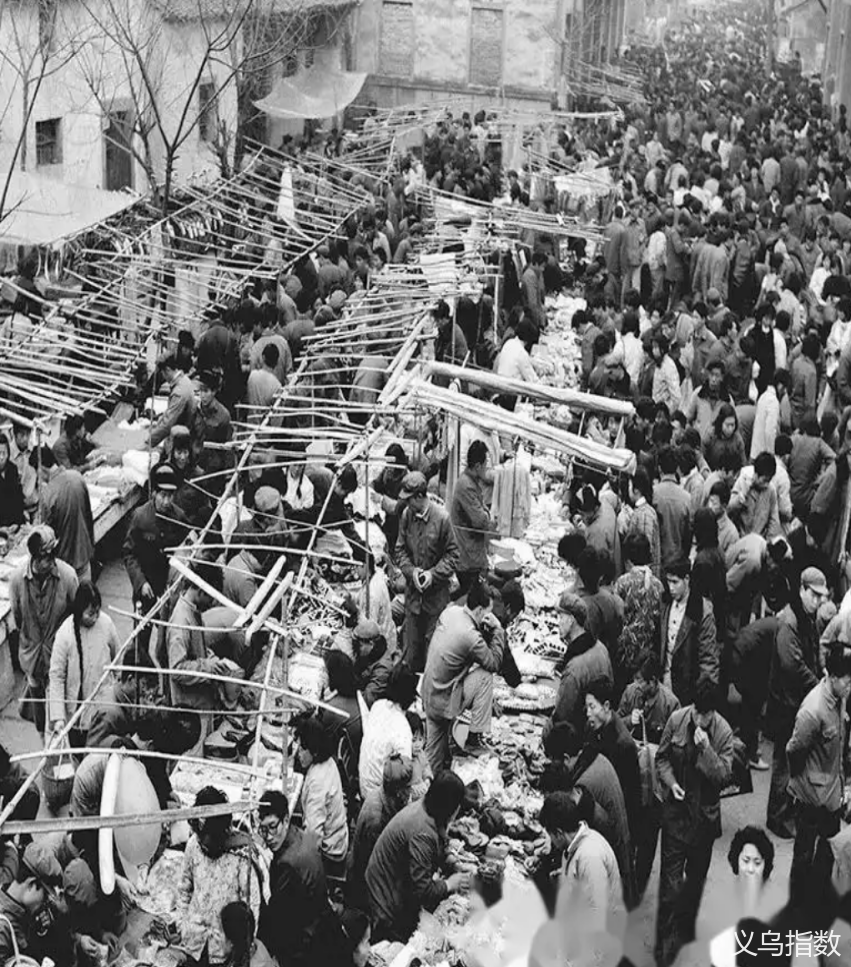
The first-generation market: Huqingmen Small Department Store Market (1982-1984) Image source: Internet
The market scale is growing increasingly large, and the number of farmers participating in small commodity trade is constantly increasing. Small commodities have gradually become the dominant and advantageous industry in the development of Yiwu. At the end of 1984, the CPC Yiwu County Committee and the Yiwu County Government broke the national economic development model of "industry first, agriculture second, and commerce last" at one stroke. They placed commerce at the top of the list and were the first in the country to formulate the strategy of "promoting commerce and building the county", determining commerce as the first pillar industry for the economic development of Yiwu County.
To thrive business, one must first have the space and field for it. In December 1984, the second-generation small commodity market located on Xinma Road in Choucheng Town was completed and renamed "Yiwu Small Commodity Market". It also set up institutions and service facilities such as industry and commerce, taxation, banks, public security and catering. In 1985, the number of stalls increased to 2,874, and the market transaction volume exceeded 50 million yuan. The second-generation small commodity markets have transformed from "street markets" to "markets based on venues", and the scope of commodity circulation has expanded to other provinces and cities.
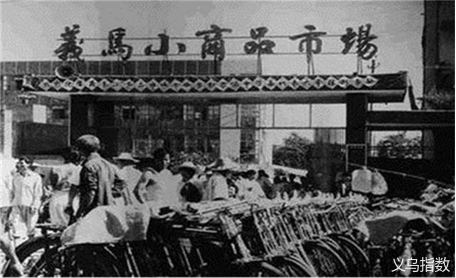
The second-generation market: Xinma Road Yiwu Small Commodities Market (1984-1986) Image source: Internet
(2) Division into cities and trading throughout the country
Less than two years after the operation of the second-generation small commodity market, the public's call for further expanding the market scale has been growing louder and louder. In September 1986, the government invested another 4.4 million yuan, and the third-generation market with over 5,000 stalls - the Yiwu Small Commodities Market on Chengzhong Road - was completed. It can accommodate 30,000 people for trading within the market, and the facilities and management services within the market have been further improved. After Yiwu was upgraded from a county to a city, it placed greater emphasis on cultivating the market and subsequently carried out several expansions. In 1990, the number of stalls increased to over ten thousand, making it the largest small commodity wholesale market in the country at that time. In 1991, the market transaction volume exceeded 1 billion yuan for the first time. The third-generation small commodity market has attracted a large number of merchants and enterprises from both within and outside the province to set up stalls, and its coverage has expanded to all regions of the country, especially exerting a considerable influence in Northeast, Northwest and North China.
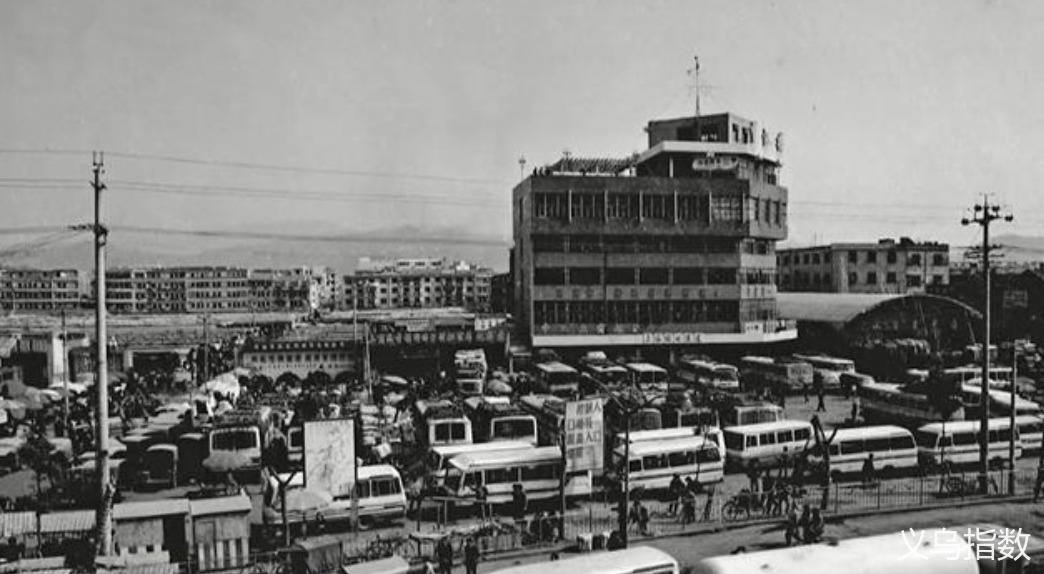
The third-generation market: Yiwu Small Commodities Market on Chengzhong Road (1986-1992) Image source: Internet
During the rapid development of the market, the conflicts between merchants and customers as well as among merchants caused by the decentralized operation of the industry have become increasingly prominent. This not only damages the market's reputation but also poses new challenges to market management. Since 1991, the market has begun to implement the management strategy of "zoning and market classification". According to the principle that similar goods are operated in the same area, thousands of kinds of goods are classified and operated in various trading areas.
This idea was put into practice in the fourth-generation market. From February 1992 to November 1995, Yiwu built the fourth-generation small commodity markets - Huangyuan Market and Binwang Market, covering an area of over 400,000 square meters. They became the largest and highest-grade indoor wholesale markets in the country at that time. The State Administration for Industry and Commerce officially named "Yiwu Small Commodities Market" as "China Small Commodities City". Since then, all industries in Yiwu Market have moved into the large hall-style indoor market, completing the historical task of comprehensive upgrading and renovation as well as overall relocation of China Commodity City.
The Fourth Generation Market: China Commodity City (1992-2001)
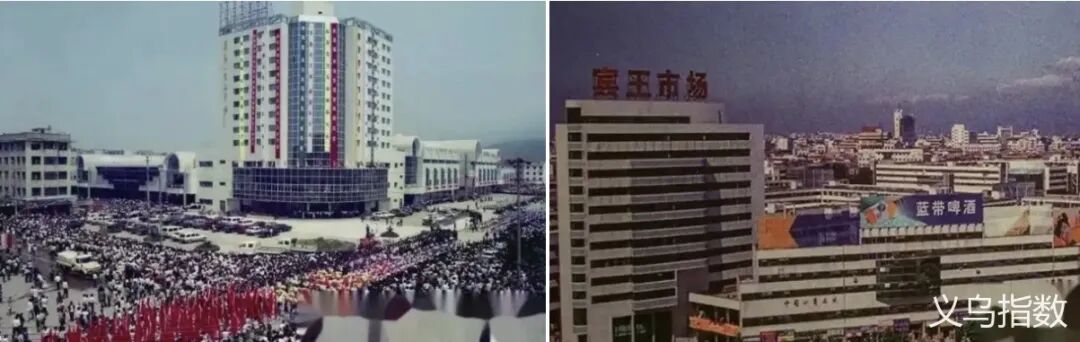
The image source of Huangyuan Market and Binwang Market: Internet
Yiwu City took the lead in implementing the ";separation of management and operation";, where the industry and Commerce Department that previously directly established the market only performed management functions. In 1993, the Yiwu Municipal Government established Zhejiang Yiwu China Commodities City Co., LTD. (later renamed Zhejiang China Commodities City Group Co., LTD.) to operate, develop, manage and serve the Yiwu Small Commodities Market.
During the same period, in response to the "market fever" that emerged across the country and the problem of "difficult business" and declining profits at the Yiwu Small Commodities Market, the Yiwu Municipal Committee of the Communist Party of China and the municipal government proposed the "Industry and Commerce Linkage"; strategy in 1994, promoting the localization of supply and the integration of production, supply and sales in the Yiwu small commodities industry, which contributed to the stable development of the Yiwu Small Commodities Market.
By the end of 1995, the transaction volume of the fourth-generation small commodity market had reached 15.2 billion yuan. The market scale advantage and radiation capacity surpass those of other domestic markets, gradually forming a pattern of "buying across the country and selling across the country".
(3) China's accession to the World Trade Organization leads to global business
China's accession to the World Trade Organization in 2001 has brought broader development space for the Yiwu market. Since its establishment in 1982, the proportion of domestic and foreign trade in Yiwu Market has undergone many changes. Before 2000, Yiwu Market was in a stage dominated by domestic trade. With the accelerated advancement of globalization, Yiwu, as an important production base for small commodities in China, has attracted an increasing number of foreign merchants to come for procurement, laying a foundation for building the fifth-generation market and further expanding the international market.
In 2002, the CPC Yiwu Municipal Committee and the Yiwu Municipal Government made efforts to build the fifth-generation specialized market for small commodities: the International Trade City. In October 2002, the market of Zone 1 of the International Trade City was officially opened. From 2002 to 2013, the first, second, third, fourth and fifth zones of the International Trade City, Xinhuangyuan Market and the International Production Materials Market were successively completed and put into use. In 2005, Yiwu was hailed by authoritative institutions such as the United Nations, the World Bank and Morgan Stanley as "the world's largest small commodity wholesale market". In the same year, the international trade volume of Yiwu exceeded the domestic trade volume for the first time.
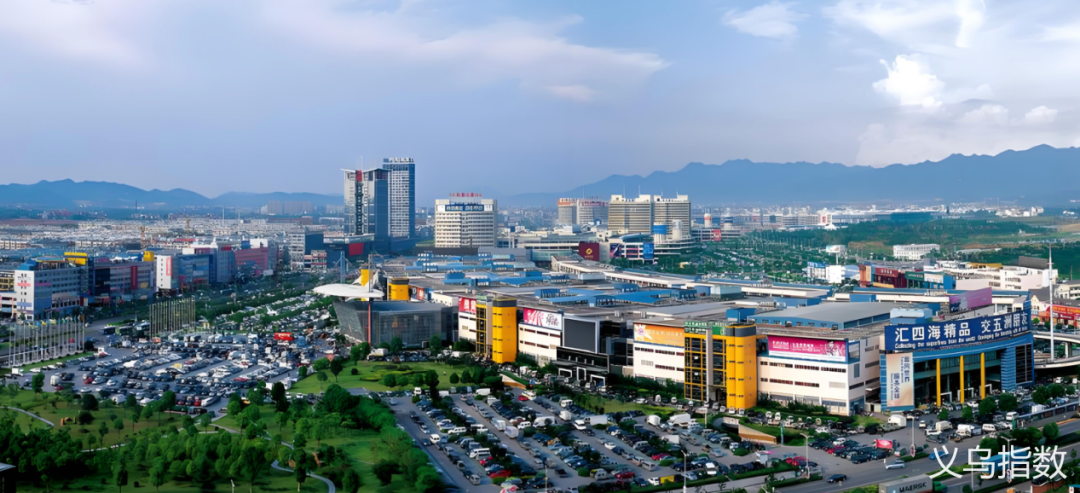
The Fifth Generation Market: International Trade City (2002- Present) Source: Yiwu Index
Today, the business area of Yiwu Market has reached over 6.4 million square meters, with 75,000 business stalls. The categories of small commodities are no longer limited to traditional daily necessities. Emerging industries such as new energy, pet supplies, and smart home appliances are also within the market's product range, covering 26 major categories and over 2.1 million types of goods. The diversified product structure not only meets the needs of different consumers It has also won Yiwu a broader market space in global trade.
Yiwu Market has trade relations with over 230 countries and regions around the world, with an outward orientation rate as high as 55%, and serves as a global barometer for small commodity trade. In 2024, the number of foreign people entering Yiwu reached 569,000, and the average daily number of foreign merchants in the International Trade City was 3,900. From January to April 2025, the total value of imports and exports in Yiwu City reached 231.31 billion yuan, increasing by 15.1% year-on-year. The shares of the total value of imports and exports, exports and imports in Zhejiang Province were 13.2%, 15.5% and 6.4% respectively.
02
From "Traditional Markets" to "Digital Trade Markets"
After five generations of market changes, Yiwu has turned its street stall business into a global one. At present, global trade, industrial chains and supply chains are undergoing unprecedented profound adjustments and changes. New trade models and forms such as digital trade, service trade and cross-border e-commerce are flourishing like bamboo shoots after a spring rain. Yiwu has also embarked on a brand-new journey of its sixth-generation market.
(1) E-commerce market replacement, with both offline and online markets running in parallel
At the beginning of the 21st century, the Internet economy rose rapidly. The development of online e-commerce platforms led to problems such as customer loss and low transaction efficiency in the physical market. In 2013, the CPC Yiwu Municipal Committee and the Yiwu Municipal Government recognized the significance of e-commerce in the transformation and upgrading of the market and introduced relevant policies to promote the "e-commerce replacing the market"; initiative. In 2018, Yiwu was selected as a comprehensive pilot zone for cross-border e-commerce. It has been making continuous efforts in five aspects: "subject cultivation, brand promotion, development space, fulfillment channels, and atmosphere creation", building a complete service system, and actively expanding the market.
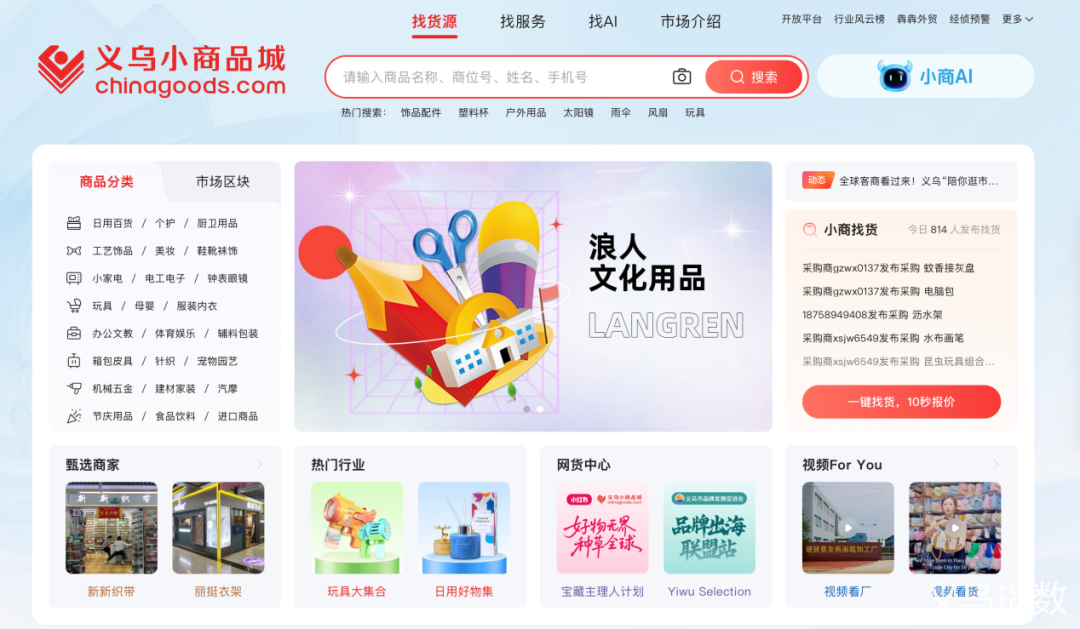
Image source of Chinagoods platform: Yiwu Index
Nowadays, new business forms such as live-streaming e-commerce and cross-border e-commerce are booming in Yiwu and have become an important part of the city's e-commerce development. A large number of merchants and supply chain enterprises provide product support for leading e-commerce platforms such as Tiktok, Amazon, and shein. As of May 2025, the number of e-commerce business entities in Yiwu City exceeded 746,300, accounting for 29.78% of the total e-commerce business entities in the province. Since the beginning of this year, 67,200 new e-commerce business entities have been established in Yiwu City, accounting for three quarters of the total number of new business entities in the Yiwu market.
(2) AI empowerment, digitalization and intelligence of trade processes
In recent years, as AI technology has gradually evolved from basic algorithm models to a stage with autonomous learning and complex decision-making capabilities, breakthroughs in technologies such as large language models and computer vision have brought about changes in the trade sector.
The way of doing business in Yiwu Market is also undergoing changes. In 2023, Yiwu released the world's first large language model in the field of commodity trade and the newly upgraded Chinagoods AI intelligent innovation service platform. Yiwu merchants have optimized the entire trade process, including production design, display and transaction, and trade fulfillment, by using AI to design products, record multilingual product promotion videos, and polish customer reception scripts.
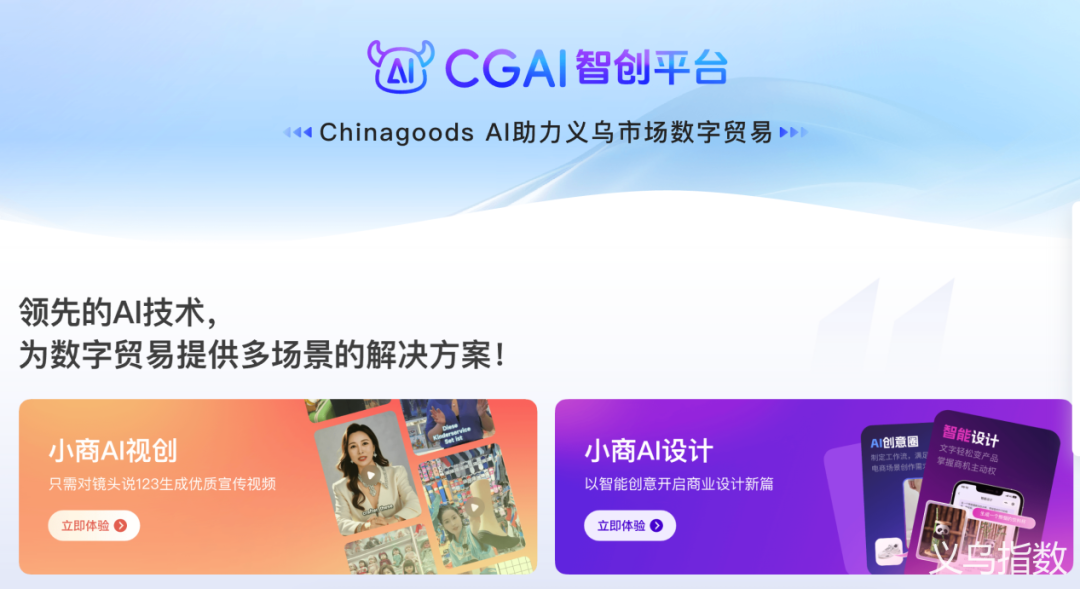
Image source: Yiwu Index. ChinagoodsAI Smart Innovation Service Platform
(3) Digital Trade Market: The sixth-generation market has been comprehensively upgraded
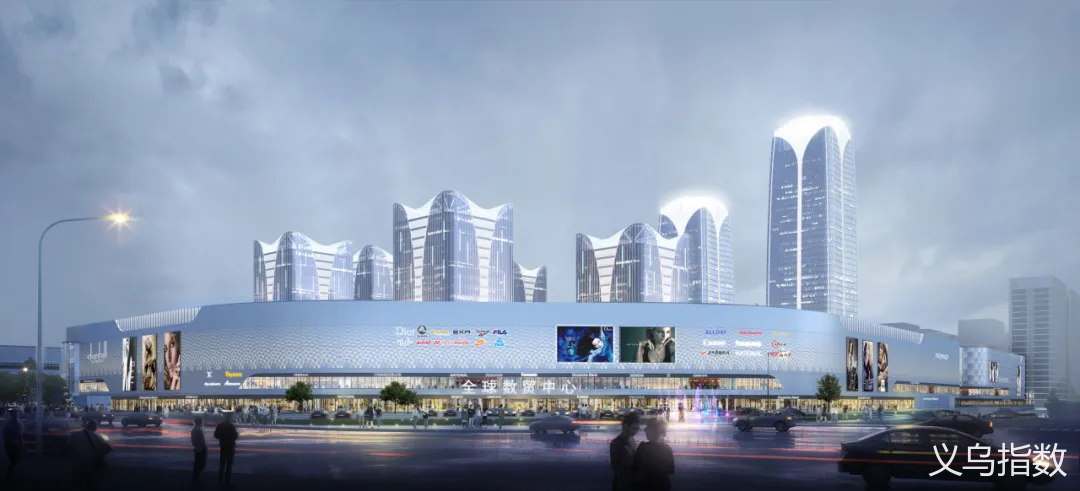
In November 2022, to meet the demands of digital trade development, the CPC Yiwu Municipal Committee and the Yiwu Municipal Government initiated the construction of the core landmark project of the sixth-generation market - the Global Digital Trade Center.
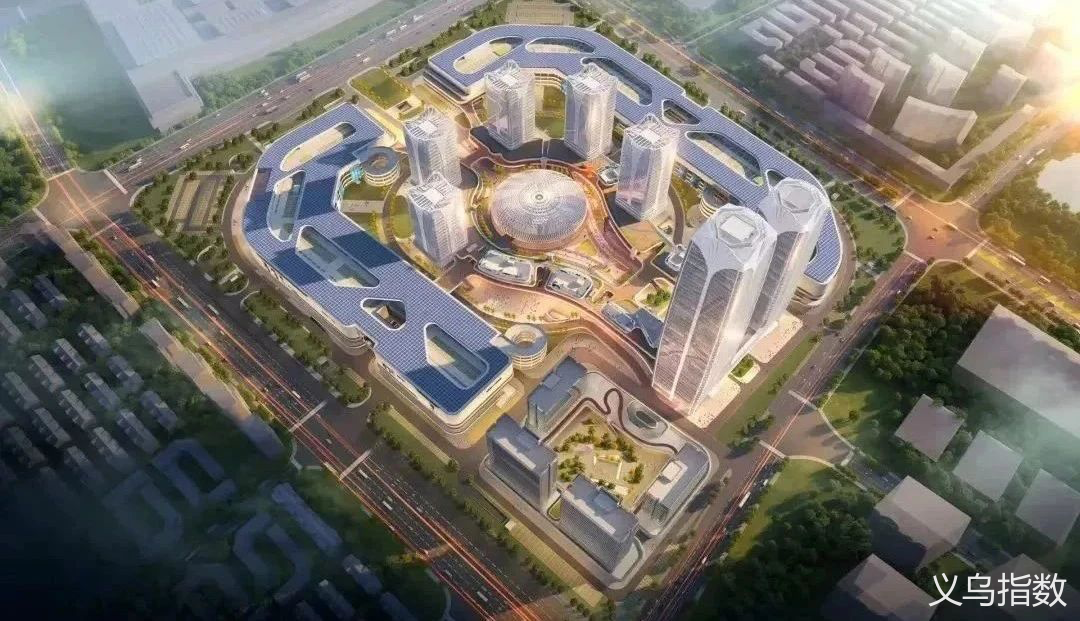
Global Digital Trade Center Image source: Yiwu Index
The project is adjacent to the fifth District of the International Trade City, located in the core area of the market. It covers a total area of 562 mu, with a construction area of 1.25 million square meters and an estimated investment of 8.3 billion yuan. The project consists of five major sections: the market, business office buildings, commercial streets, apartments, and the digital brain. It centers on three main lines: new trade, new markets, and new landmarks, and integrates three major Spaces: production, living, and ecology. It aims to create a global trade benchmark that is fashionable, international, modern, digital, and low-carbon.
This project focuses on five cutting-edge industries: fashion beauty and accessories, infant and toddler products, health and leisure outdoor activities, fashion clothing fabrics, and unmanned aerial vehicles and artificial intelligence equipment. Through innovative models such as "commercial upstairs", "scenario-based exhibition and trade", and "digital ecosystem empowerment", we promote the transformation of traditional trade to "digital trade transactions", and build a digital ecosystem covering all elements including "people, goods, places, information flow, goods flow, and capital flow".
Yiwu has achieved multiple generations of market renewal through down-to-earth efforts and timely innovation, created a model of county-level economy, and paved the way for the world's small commodity trade.
In the future, driven by the continuous wave of digital trade, the Yiwu market will embrace a broader space for development.
—— The content of this article is translated by Al ——
 My favorites