

From industrial to civilian use, consumer-grade 3D printing has ushered in the "iPhone moment"
Publish Time:2025-12-15 11:23:56Pageviews:838


abstract: 3D printing is no longer merely a tool in factories; it has become a "desktop factory" for individuals, makers, and small and micro enterprises to realize their creativity and meet their personalized needs. 3D printing technology is integrating with Yiwu's business model, giving rise to new consumption experiences and creative patterns.
From the custom-made trendy toys favored by Generation Z to the highly realistic anime props in the hands of cosplayers...
Under the new consumption wave, as personalized and customized demands become increasingly rigid, consumer-grade 3D printing is gradually upgrading to a productivity tool.
In 2024, the global consumer 3D printing market size was 4.1 billion US dollars, and it is expected to grow to 16.9 billion US dollars by 2029, with a compound annual growth rate as high as 33%.
Just four Shenzhen-based enterprises, namely Creality 3D, Tuozhu Technology, Creality and Smart, collectively hold 90% of the global entry-level 3D printer market share and are known as the "Four Little Dragons" of consumer 3D printing.
In this article, Yiwu Index takes you through consumer-grade 3D printing technology.
01
The market holds great promise, and consumer-grade 3D printing is approaching a turning point of explosive growth
3D printing technology, also known as additive manufacturing technology. Additive manufacturing is about "adding only", adding materials layer by layer until the object takes shape. In simple terms, if traditional manufacturing is like carving a statue out of a stone, then 3D printing is like stacking Lego blocks layer by layer to create any shape you want.
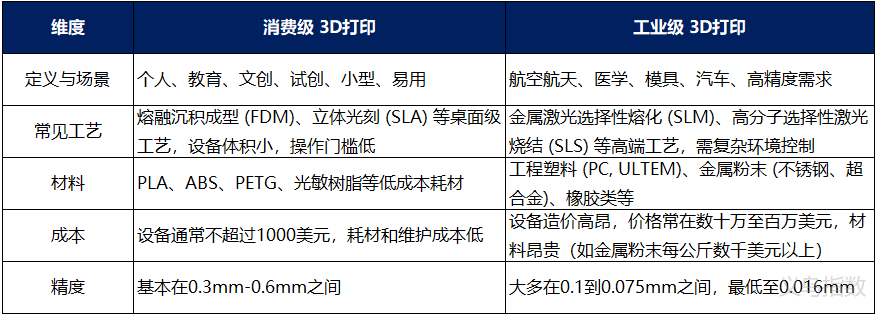
At present, 3D printing can be classified into consumer-grade 3D printing and industrial-grade 3D printing based on their application scenarios. There are differences between the two in terms of process, precision, cost and other aspects.
Comparison between consumer-grade 3D printing and industrial-grade 3D printing
Source of information: Collation of public information
www.ywindex.com
In simple terms, consumer-grade 3D printing refers to 3D printing equipment and related services for individuals, families, and small studios. Its core features are "low cost, easy operation, and small size", which can meet personalized production needs.
Under the new consumption wave, global demand continues to surge
"Consumer-grade 3D printing has ushered in the iPhone moment."
The "iPhone moment" metaphorically implies that a certain industry has reached a tipping point. Nowadays, the development of consumer-grade 3D printers has passed the early trial stage and entered the era of mass consumption.
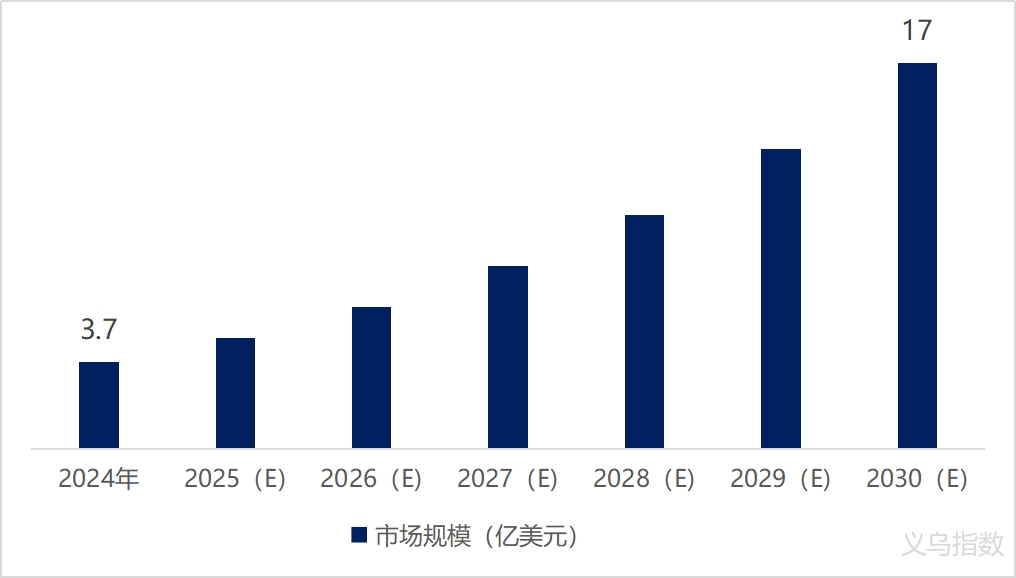
From the perspective of the Chinese market, market demand is growing rapidly. In 2024, China's consumer 3D printing market generated 370 million US dollars in revenue and is expected to reach 1.7 billion US dollars by 2030, with a compound annual growth rate of 28.3%. This growth rate is much higher than the general growth level of 3% to 5% for mature consumer electronics categories such as traditional home appliances and mobile phones.
The market size of consumer 3D printers in China (in billions of US dollars)
Data source: GRAND VIEW
www.ywindex.com
China is not only an emerging market for consumer-grade 3D printing but also a global supply center. Data shows that in the first quarter of 2025, the global shipment of entry-level 3D printers exceeded one million units, a year-on-year increase of 15%, with China accounting for 95% of them. As the largest 3D printing manufacturing and export base in China, Guangdong has a distinct industrial cluster effect. The "Four Little Dragons" of consumer-grade 3D printing, represented by Creality 3D, Tuozhu Technology, Creality and Smart, have occupied 90% of the global entry-level 3D printer market share.
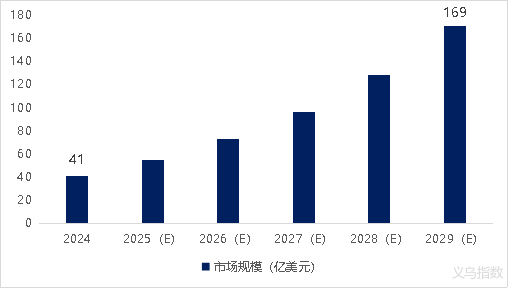
From a global market perspective, the market is experiencing a phased boom. In recent years, the search popularity of 3D printing on Google has shown a significant upward trend, and the total sales of such products on Amazon have also achieved continuous growth. The global consumer 3D printing market size was 4.1 billion US dollars in 2024 and is expected to grow to 16.9 billion US dollars by 2029, with a compound annual growth rate as high as 33%.
The global consumer 3D printing market size from 2024 to 2029 (in billions of US dollars
Data source: Guojin Securities Research Institute
www.ywindex.com
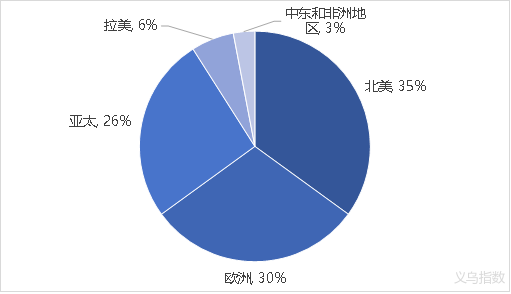
At present, the consumer-grade 3D printing market is still dominated by Europe and America. As the early birthplaces of 3D printing technology, their markets are mature and their scales are relatively leading. A relatively mature consumer-grade 3D printing ecosystem has been formed in Europe and America. It not only boasts an active maker culture and a complete DIY atmosphere, but also has a high consumption capacity and technological acceptance.
The market share of global consumer-grade 3D printing in different regions
Data source: Precedence Research, Guojin Securities Research Institute
www.ywindex.com
Three major factors are driving the continuous popularity of consumer-grade 3D printing
The rapid growth of the consumer-grade 3D printing market is mainly driven by the following three major forces
Technological innovation has significantly lowered the threshold for use. In terms of functionality, consumer-grade 3D printing has gradually approached professional performance. Intelligent features such as AI calibration and multi-color printing have significantly enhanced accuracy and ease of operation, making it "user-friendly for beginners". In terms of price, the costs of both equipment and consumables have dropped significantly. For instance, the price of basic models has dropped to the thousand-yuan level, which is comparable to that of ordinary electronic products. The prices of consumables have generally been halved, with some prices dropping by up to 70%. Entry-level consumables are only 40 yuan per kilogram. At the same time, the equipment's lifespan can reach 10,000 hours, with outstanding cost performance.
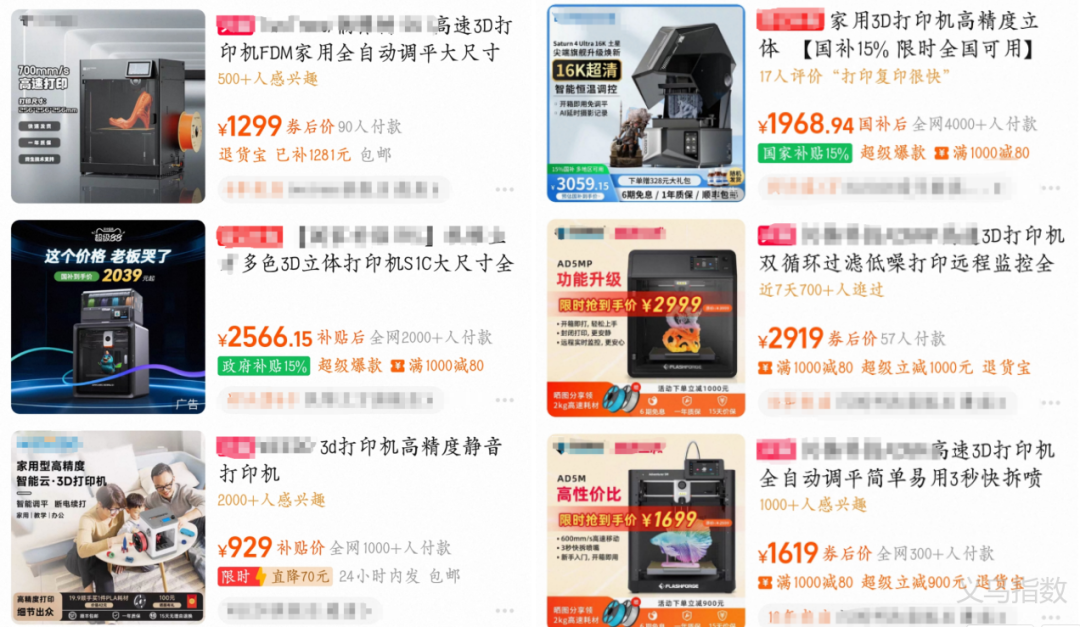
The price displayed when searching for "3D printing" on a certain platform is sourced from the Internet
The deep integration of AI and 3D printing is another key driver for the market's explosive growth. The highest threshold for 3D printing still lies in modeling. The emergence of generative AI technology has driven a revolution of "vanishing design thresholds", allowing users to create models without having professional modeling knowledge. Meanwhile, AI empowerment drives the prosperity of the content ecosystem, and leading brands build shared model communities. The 3D model community represented by MakerWorld gathers a vast number of creative models, allowing users to access them for free or at a low cost. Users can quickly generate usable models simply by describing them in text or pictures, which greatly shortens the design process and makes personal creation more convenient than ever before.
An important driver of the "trendy toy economy". The breakthrough of consumer-grade 3D printing is inseparable from the continuous popularity of the trendy toy economy. This year, various phenomenon-level ips have become extremely popular worldwide, leading to a situation where "one child is hard to come by" in the market. Young people, unable to obtain limited edition products, have turned their attention to 3D printing. Consumer-grade 3D printing precisely meets consumers' personalized emotional value demands and fills the market gap caused by scarcity. Therefore, 3D printing technology, with its advantages of short production time and low cost, can greatly stimulate market demand in the context of the rapid development of the cultural and creative and trendy toy industries.
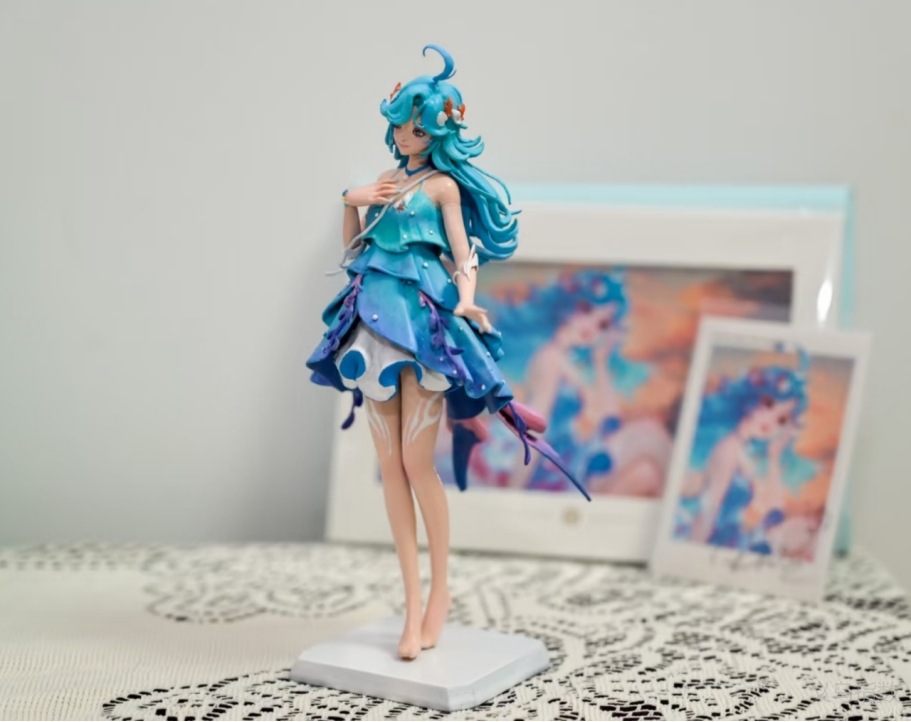
The source of the 3D printed character model of a certain mobile game: The Internet
02
"Everything can be 3D printed.
The core value of consumer-grade 3D printing lies in breaking the shackles of standardized production, providing the possibility of low-cost, short-cycle sampling and small-batch production. Its flexible production advantage of small orders and quick returns can meet the personalized and differentiated consumption demands in the new consumption wave.
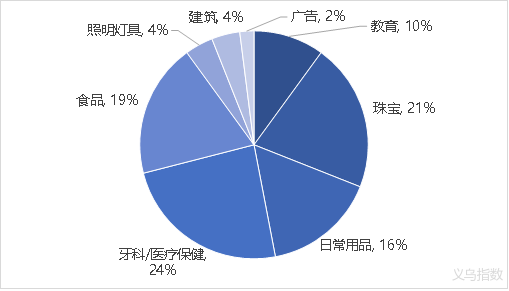
Driven by multiple factors, the application scenarios of consumer-grade 3D printing technology are becoming increasingly diverse, especially in fields such as consumer goods, education, and cultural and creative industries.
The application share of the global consumer 3D printer market
Data source: Formlabs, Research Institute of Zheshang Securities
www.ywindex.com
In the field of cultural and creative collectibles, consumer-grade 3D printing has become an important engine driving the development of the cultural and creative collectibles sector. It serves both as a "personality amplifier" and a "creative catalyst", serving individual creators who pursue "collectible freedom" and helping cultural and creative enterprises significantly lower the threshold for personalized production. For instance, animal models and personal cultural and creative products commonly seen in markets are mass-produced through 3D printing, with the cost per piece being controlled at around 2 yuan.
In the field of jewelry and accessories: Consumer-grade 3D printing can create more complex jewelry, achieving "beauty that traditional craftsmanship cannot achieve", and freeing designers from the constraints of "whether the craftsmanship can be realized". Complex hollowed-out designs, micro-inlaid precise structures, and gradient metal textures - all these shapes that were discarded due to the high difficulty and scrap rate of manual production can be precisely achieved through 3D printing. Meanwhile, 3D printing technology can also enhance the efficiency of design and proofing, and reduce the time cost of pattern making.

The source of the 3D printed jewelry image: Internet
In the consumer goods sector, 3D printing plays the role of a "universal filler", precisely filling the gap in personalized demands that standardized products fail to meet. This direction has become a relatively mature and large-scale application in current consumer-grade 3D printing, mainly serving DIY enthusiasts, home users, small and micro entrepreneurs, and life-oriented users who value practicality. Its applications are mostly concentrated in the production of small items and functional components, such as home repairs, custom tools and other specific scenarios.
In the field of education, the main users of 3D printing are those in the STEM education systems of universities, vocational colleges, and primary and secondary schools. It is often used in structural teaching, model demonstrations, and creative project practices. It can visually present concepts such as physics, mechanics, and architecture, lower the threshold for students to create with their hands, and enhance their innovation capabilities. Meanwhile, it can be deeply integrated with disciplines such as programming, mechanical structure, and electronic production, promoting interdisciplinary teaching. For instance, making student works such as gears, mechanisms, and architectural models, or printing teaching models like chemical molecules, geographical features, and biological structures.
In addition, consumer-grade 3D printing is continuously penetrating into fields such as healthcare, construction, and food, demonstrating broad application prospects and sustained innovative vitality.

The source of the 3D-printed chemical structure model image: Internet
03
Trends in consumer-grade 3D printing: smarter, more realistic, and more widespread
With the continuous advancement of the innovation wave, consumer-grade 3D printing technology is evolving towards lower entry barriers, stronger capabilities, and better materials.
The deep integration of AI makes printing smarter. The deep integration of AI and 3D printing will become a core trend, driving equipment to transform from "semi-automatic operation" to "full-process intelligence", and further lowering the threshold for use. In addition to significantly lowering the threshold for 3D printing design and creation, AI-generated models are also developing towards the directions of automatically identifying model defects and optimizing structures, as well as real-time monitoring of the printing process, thereby enhancing printing efficiency and cost quality, and reducing the cost of trial and error. This "AI+3D printing" model has transformed the concept of "what you think is what you get" into a daily experience, further achieving an upgrade in "intelligent creation".
User penetration is deeper and application scenarios are broader. Although the global market penetration rate of consumer-grade 3D printing is still at a relatively low level at present, its scale and penetration rate are rapidly increasing. For instance, on platforms like Douyin, the play count of content related to "3D printing" has exceeded 10 billion times, and the sub-topics have also received hundreds of millions of followers. More and more users are paying attention to 3D printing. Meanwhile, the business model of manufacturers has gradually shifted from merely selling hardware to building an integrated ecosystem of "hardware + software + services". The application scenarios of technology have been continuously expanding and have permeated multiple fields such as education, healthcare, fashion, and construction. "Everything can be printed" is moving from a trend to reality.
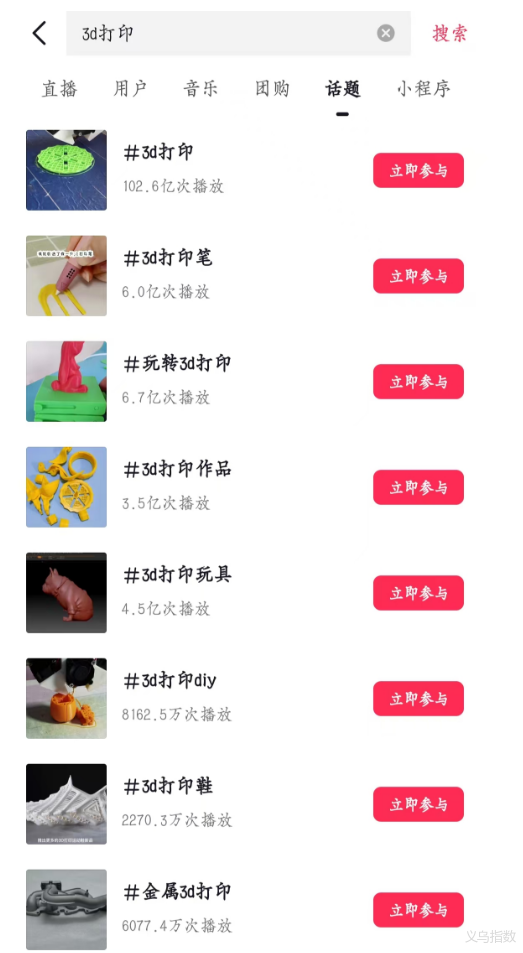
The number of plays of the 3D printing topic on Douyin platform. Source: Douyin
The material printing is more realistic and environmentally friendly. Material innovation will be the key for 3D printing to expand its application boundaries. Functional, environmentally friendly and diversified materials will gradually become the mainstream in the market. The early basic plastic materials had single properties and were difficult to meet the advanced demands such as realism, durability and environmental protection. New materials are specifically addressing these issues: with the help of an automatic material switching system, a single print can blend multiple types of materials such as rigid, flexible, transparent, and colored ones, making the printed products more realistic. Environmentally friendly materials respond to the "dual carbon" trend and meet the green demands of families and the cultural and creative industries. Functional materials (such as conductive and high-temperature resistant materials) have enabled 3D printing to extend into fields like electronic accessories and simple tools.
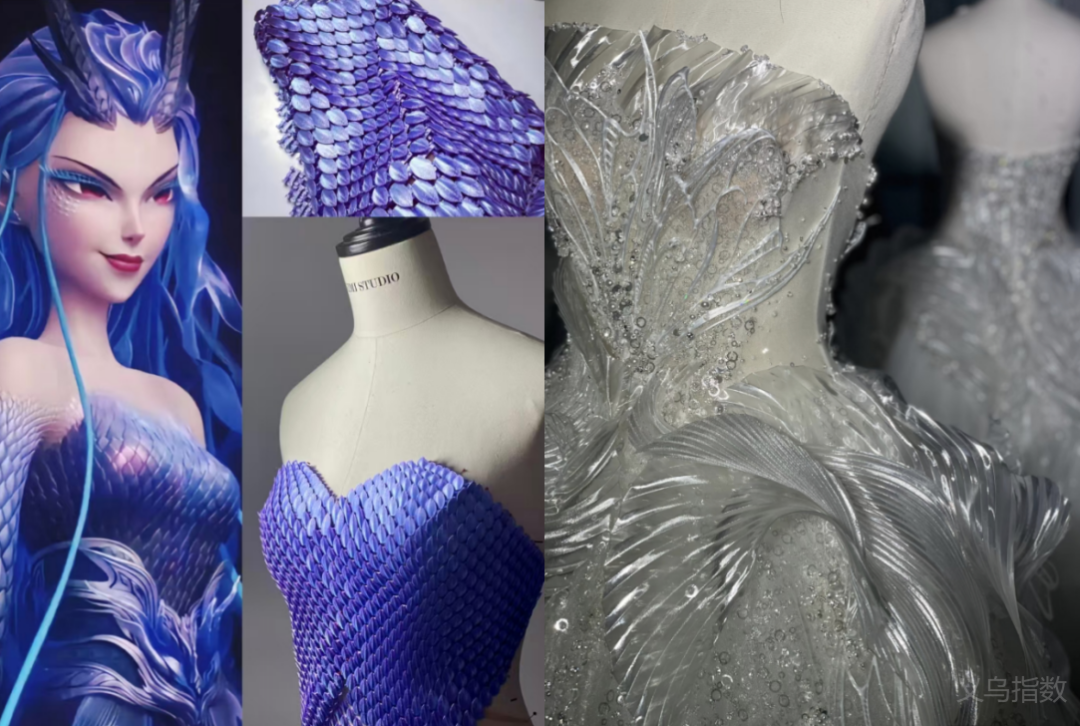
The image source of the clothing made by a certain designer with 3D printing: Internet
04
Yiwu builds a 3D printing ecosystem, connecting creativity with the market
Fast style updates, quick sample updates, and prompt order delivery. This is a characteristic of small commodity sales. At present, the demand for small-batch and multi-style products in the downstream consumer market is increasing day by day, and 3D printing perfectly meets this trend with its advantage of small orders and quick returns.
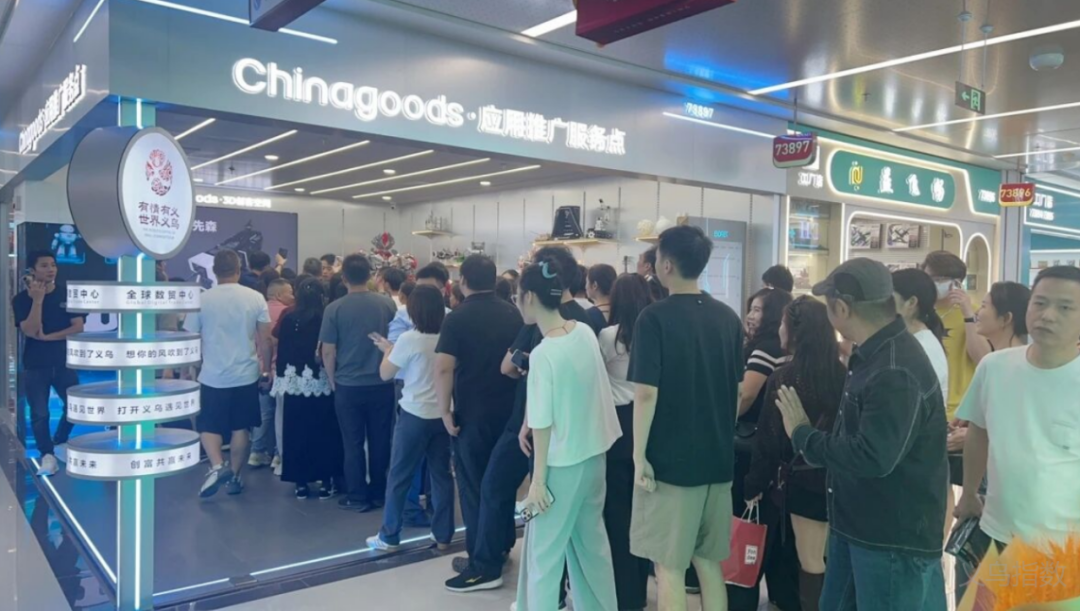
The 3D printing Maker Center on the third floor of the Global Digital Trade Center. Image source: Yiwu Index
Yiwu is striving to build a 3D printing service sharing system that features "zero threshold, low cost and fast iteration", and to construct an AI+3D printing ecosystem. The 3D Printing Maker Center, located on the third floor of the Global Digital Trade Center, is dedicated to connecting creativity with the market and addressing the pain points in the industrial chain of "having creativity but lacking a market" and "having ideas but lacking design". Provide low-threshold AI design tools for creative but lacking design capabilities business operators; For ideas that require physical verification, 3D printing can achieve rapid and low-cost sample production. For business operators with higher design demands, we link up national maker resources and introduce an "external creative brain". This closed-loop service connects the entire chain from "design - manufacturing - trade", accelerating the transformation of creativity into products and promoting the in-depth integration of technological innovation and industrial upgrading.
This is not only a successful application of 3D printing technology, but also a deep integration of technological innovation and the small commodity industry chain.
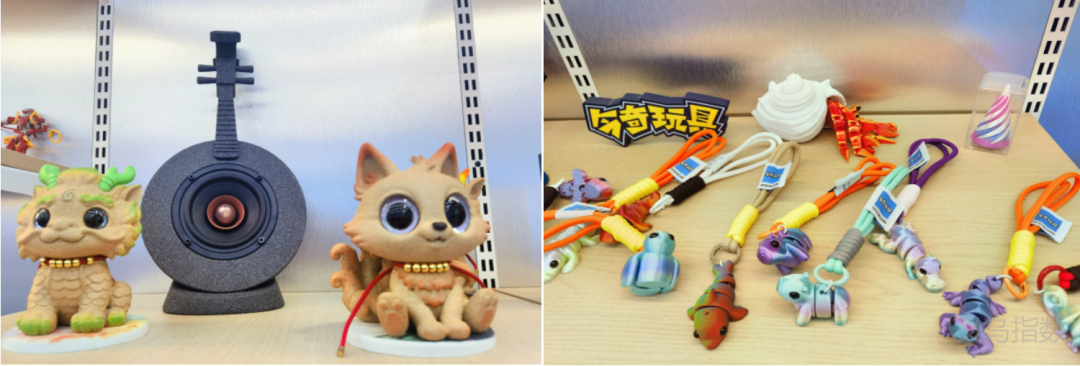
The sample image displayed in the 3D Printing Maker Center on the third floor of the Global Digital Trade Center is sourced from Yiwu Index
Conclusion
3D printing is no longer merely a tool in factories; it has become a "desktop factory" for individuals, makers, and small and micro enterprises to realize their creativity and meet their personalized needs. 3D printing technology is integrating with Yiwu's business model, giving rise to new consumption experiences and creative patterns.
—— The content of this article is translated by Al ——
 My favorites