

AI digital humans combined with trade create 24-hour non-stop productivity
Publish Time:2026-02-25 14:57:13Pageviews:801


abstract: With the continuous iteration and empowerment of large models and AI technologies, the commercial value of the digital human race has become increasingly prominent. The pace of capital and enterprises' entry has accelerated simultaneously, and a new round of fierce competition in the industry has already begun.
AI has brought an end to the era of "digital humans" as tools.
At the beginning of 2026, ByteDance released FlowAct-R1, a real-time interactive digital human video generation framework. With just a single reference image and audio, it can stream and generate full-body dynamic videos of unlimited duration, achieving for the first time the impossible triangle of "high fidelity, real-time interaction, and unlimited duration" for digital humans simultaneously.
This means that a "super streamer" with a lively expression, fluent responses and the ability to broadcast non-stop for 24 hours is technically in place.
In June 2025, Luo Yonghao's "digital avatar" achieved a GMV that surpassed his one-hour live-streaming performance in just 26 minutes.
With the continuous iteration and empowerment of large models and AI technologies, the commercial value of the digital human race has become increasingly prominent. The pace of capital and enterprises' entry has accelerated simultaneously, and a new round of fierce competition in the industry has already begun.
In this article, Yiwu Index will interpret AI digital humans for you.
01
AI Digital Human: A New interactive medium where the virtual and the real coexist
What is an AI digital human?
Many people mistakenly believe that AI digital humans are merely "realistic virtual avatars", but in essence, they are a composite product of the deep integration of multiple fields such as computer graphics, artificial intelligence, interaction technology, and speech synthesis. The core of this product is "both form and spirit" - it not only has a human-like external form but also an intelligent internal driving force.
Compared with the early virtual avatars mainly presented through animation, the new generation of AI digital humans can sense external input, respond in real time, and continuously output content. This is also the prerequisite for it to truly enter commercial application.
Take Luo Yonghao's digital human live-streaming room as an example. In just 26 minutes of live-streaming, its GMV surpassed that of his one-hour live stream with a real person. In high-intensity and long-duration live streaming scenarios, "never-tiring" digital human streamers are demonstrating efficiency advantages far exceeding those of traditional human labor.
(1) From "marionettes" to "autonomous interaction", a technological inflection point is taking place
In the early stage of development, digital humans had obvious shortcomings such as weak intelligent interaction capabilities, insufficient movement accuracy, and poor image realism.
The core of traditional digital humans lies in lip movement technology: voice input is only responsible for synchronizing mouth shapes, and most of the body movements outside the face rely on pre-recording and manual arrangement. Essentially, it is more like a "controlled marionet", unable to understand semantics and also difficult to cope with the immediate changes in real scenes.
In recent years, with the development of large model technology, two key capabilities have been injected into digital human technology. On the one hand, the improvement of language comprehension and decision-making capabilities has endowed digital humans with a "soul", enabling them to understand users' intentions based on context, interact with the outside world independently and generate response logic, and continuously adjust their expression methods in multiple rounds of conversations instead of passively playing content.
On the other hand, the dynamic generation capabilities of body language and expressions have become more mature. Movements are no longer prefabricated templates but can be generated in real time based on semantics and even interact with external scenes. Take live streaming as an example. When the interactive semantics switch from "introducing products" to "responding to doubts", the posture, gestures and expressions of AI digital humans can be adjusted synchronously instead of being repeatedly called for fixed actions. This makes it possible for digital humans to have "scene perception".
This technological inflection point was more intuitively verified in early 2026. In January this year, ByteDance's intelligent creation team released a Demo video of FlowAct-R1. For the first time, digital humans achieved the unification of 25fps real-time generation, 1.5-second first frame delay and streaming infinite length output in high-fidelity picture quality, which was regarded by the industry as a key breakthrough in the ";impossible triangle" of digital humans.
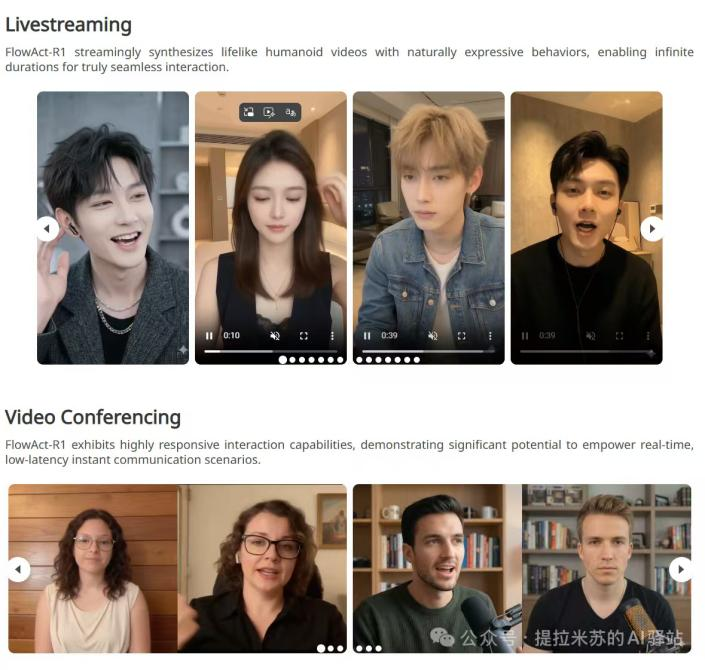
The large number of video Demo images generated by FlowAct-R1 are sourced from the Internet
Looking back at the development path of AI digital humans, its essence is a history of technological evolution from "visual simulation" to "cognition and interaction".
The development history of digital humans
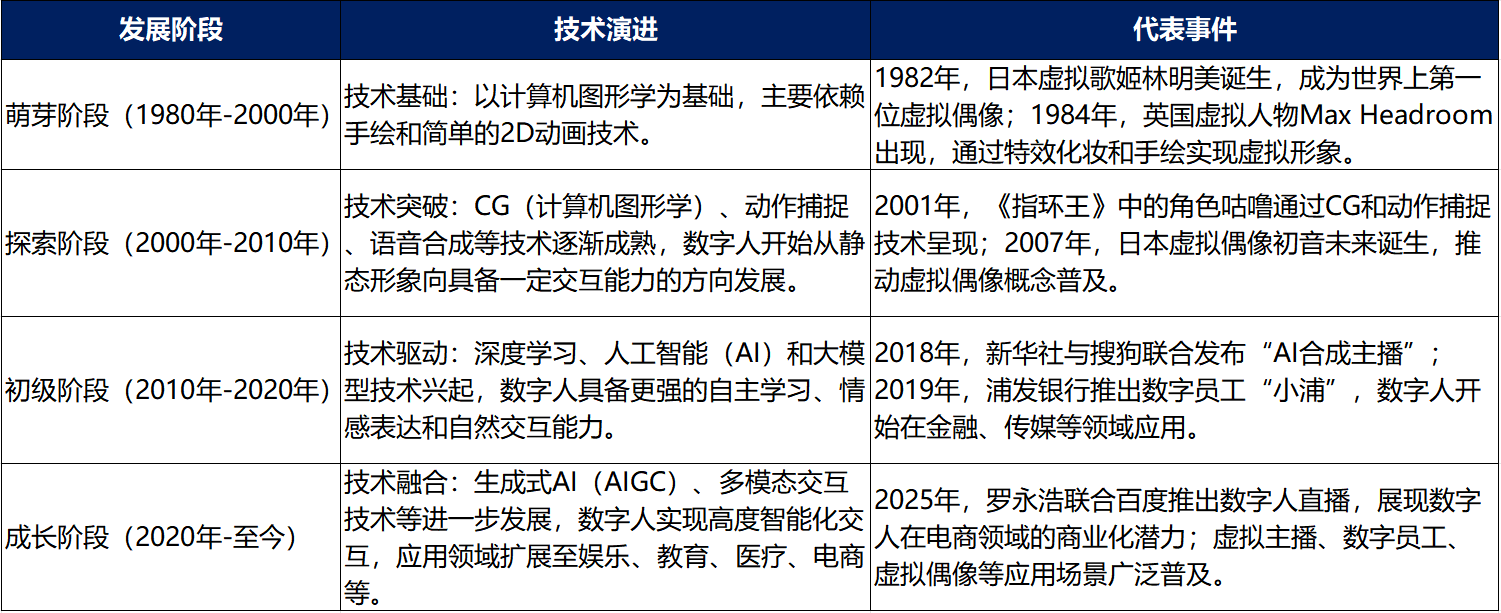
Source of information: Collation of public information
www.ywindex.com
(2) 2D takes the lead, and the era of "digital humans for all" is accelerating its arrival
At present, AI digital humans can be classified into three major categories based on their functions and application scenarios:
The first category is identity-based digital humans, whose core is to replace or assist real people in content broadcasting and performance, such as virtual anchors, virtual idols, virtual hosts, etc. This is also currently the most mature and widely implemented type of application, with application scenarios accounting for approximately 50%. The digital host "Xiao Yang" of Hunan Satellite TV and the sign language digital anchor of CCTV during the Winter Olympics are both representative cases of this stage.

Image source: Hunan Satellite TV official Account. Digital host "Xiao Yang" of Hunan Satellite TV
The second category is service-oriented digital humans. The focus of this type of digital human is not on "image", but on providing standardized and process-oriented interactive services, such as digital employees, intelligent customer service, virtual tour guides, etc. It has now entered a large-scale "consulting and service" stage, accounting for approximately 30%. Its value lies in cost reduction and efficiency improvement. For instance, digital customer service can operate 24/7.

The AI digital avatar created by SenseTime Ruying is sourced from the official account of SenseTime Technology
The third category is industry-oriented digital humans, which is the earliest but also widely regarded as a "deep water zone" (with high technical and implementation difficulties) direction, accounting for approximately 20%. The core of it is to deeply integrate digital humans with industry knowledge and professional processes, such as AI doctor assistants in the medical field, virtual teachers in the education field, and financial advisors in the financial field, etc. Take SenseTime as an example. Its digital humans have been applied on a large scale in multiple industries such as culture and tourism, finance, and education.
Data shows that the market size of AI digital humans in China reached 6.59 billion yuan in 2025, with a year-on-year growth of 60%. It is expected that by 2029, the market size will reach 25.05 billion yuan, with a compound annual growth rate of 43.5% from 2024 to 2029.
The market size of AI digital humans in China from 2023 to 2029 (in billions of yuan)
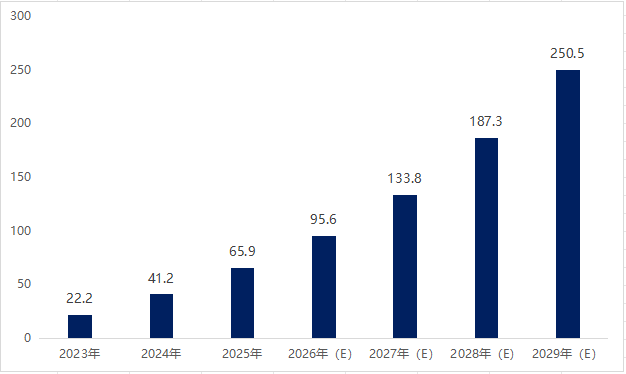
Data source: IDC Consulting (Note: The market revenue data in this study mainly comes from the annual revenue of Platform as a Service (Paas) and Software as a Service (Saas) in the A1 digital human market in China in 2024).
www.ywindex.com
According to the technical category, AI digital humans can also be divided into 2D digital humans and 3D digital humans. The current market is in a stage where the large-scale application of 2D digital humans is driving a market explosion. In 2024, the market size of 2D digital humans reached 2.89 billion yuan, with a year-on-year growth rate as high as 101.2%, becoming the main driver of market growth. Compared with 3D digital humans, which have higher requirements for real-time performance and computing power, 2D digital humans have lower deployment thresholds, more flexible applications, and are easier to integrate with existing scenarios such as live streaming, e-commerce, and content production, achieving large-scale replication first.
The rapid growth of the digital human market is not merely driven by technological progress, but rather by the combined effect of enterprises' urgent need for cost reduction and efficiency improvement and the maturity of AI capabilities.
The rapid decline in costs has laid the foundation for large-scale application. With the acceleration of technological iteration and the intensification of competition among manufacturers, the prices of digital human products have entered the "era of popularization". At present, the production cost of a single digital human has dropped to several hundred to tens of thousands of yuan. Products priced at thousands or tens of thousands of yuan are gradually becoming the mainstream in the market, and the application threshold has been significantly lowered.
02
The spillover of technological capabilities leads to the formation of an industrial pattern
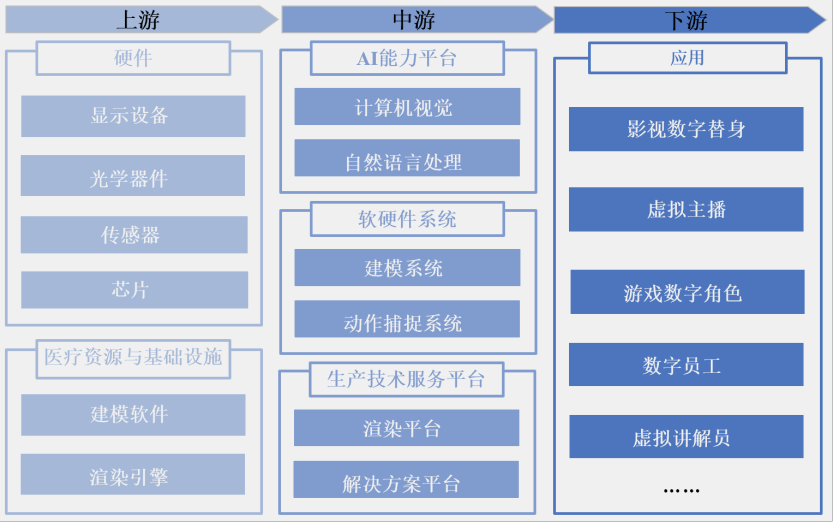
With the rapid development of the digital human industry, the current AI digital human industry chain presents the characteristics of highly concentrated upstream technical capabilities, a large number of midstream manufacturers with fierce competition, and scattered downstream application scenarios with significant differences in demand.
The upstream is the technical foundation of the entire industrial chain, mainly providing computing power, cloud services, large models, as well as basic technologies and general capabilities such as voice and vision. Overall, it features large investment in research and development, high technical barriers, and highly concentrated capabilities.
The midstream takes on the role of capability integration and productization, providing deliverable digital human platforms and solutions, specifically including the creation of digital human images, drive systems, and the construction of application capabilities for different industries.
The downstream sector focuses on specific applications and scenario implementation, providing digital human services in areas such as customer service, marketing, government affairs, and education. Due to its high reliance on specific business operations, downstream demands are difficult to standardize and are often dominated by large Internet platforms or industry clients, such as Alibaba's practice in e-commerce digital humans and local governments' efforts in government digital humans.
AI Digital human Industry Chain map
Source: China Academy of Information and Communications Technology
www.ywindex.com
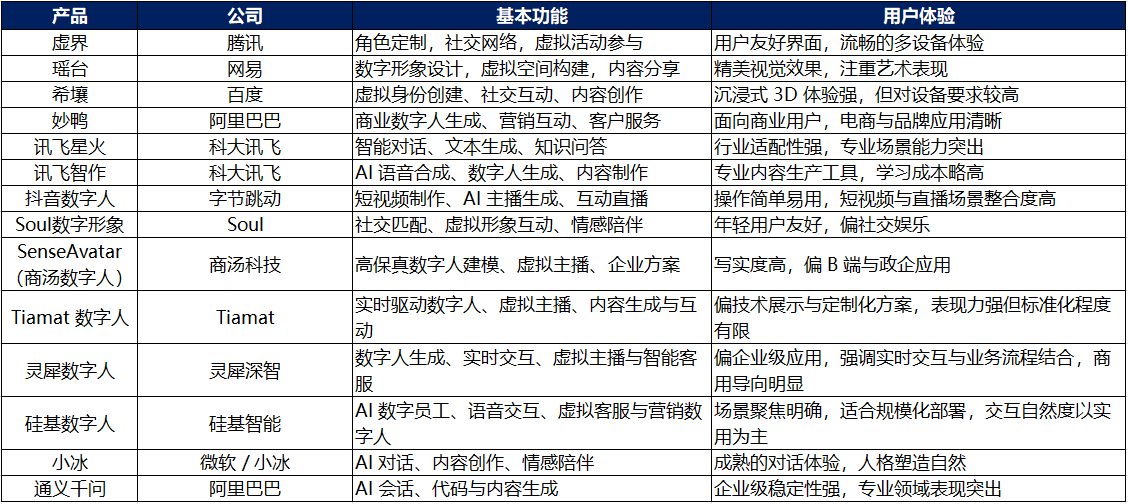
At present, the domestic digital human industry has formed three core competitive tiers:
The first group is the camp of tech giants: represented by Baidu, Tencent, Alibaba, NetEase and iFLYTEK, they rely on large model technology, ecological resources and computing power infrastructure to lead platform-based services.
The second category is AI technology providers: such as SenseTime and Xiaoice, which focus on multimodal interaction and generative AI technologies, providing middle platform capabilities for the industry.
The third category is vertical field innovation enterprises: including Lingxi Shenzhi, Silicon-based Intelligence, and Tiamat, which focus on in-depth customization for specific application scenarios.
The main products and application scenarios of AI digital humans
Source of information: Collation of public information
www.ywindex.com
With the maturation of end-to-end solutions by platform enterprises and the accelerated implementation of pure AI technology routes, traditional links such as motion capture, graphic rendering, and image library construction are gradually being replaced by AI, and the digital human industry chain is showing a significant shortening trend.
03
When AI digital humans enter trade and business, the productivity structure of foreign trade is rewritten
The core competitiveness of AI digital humans lies in "breaking the boundary between the virtual and the real with technology", enabling digital entities to break through capability limitations, replace some repetitive labor, and serve humanity. In the field of business and trade, especially in the context of foreign trade, this value is accelerating its manifestation.
The first is to create a 24-hour non-stop "gold medal sales". AI digital human live streaming is one of the most mature and valuable core scenarios for its implementation. It not only enables 7× 24-hour non-stop live streaming but also generates 360° ultra-realistic avatars, supporting precise actions such as turning around, try-on, and close-up display. It can even achieve interaction between the host and the assistant on the same screen, creating an atmosphere comparable to that of a real-person live streaming room. At the Yiwu Global Digital Trade Center, many merchants have achieved regular attendance of AI anchors by combining real people with multiple AI digital human live-streaming avatars. Their live-streaming covers prime time in over a dozen countries, ensuring that their business never closes.
The second is to change the way of cross-language communication. Through the video generation and automatic translation capabilities of multilingual digital human anchors, merchants in Yiwu can enter the minority language market with a relatively low threshold, continuously output standardized product introductions and brand content, and reduce the cost of cross-language communication. Foreign trade exchanges have shifted from the past "limited accessibility" to "wide accessibility", and language is no longer the primary threshold for expanding overseas markets.
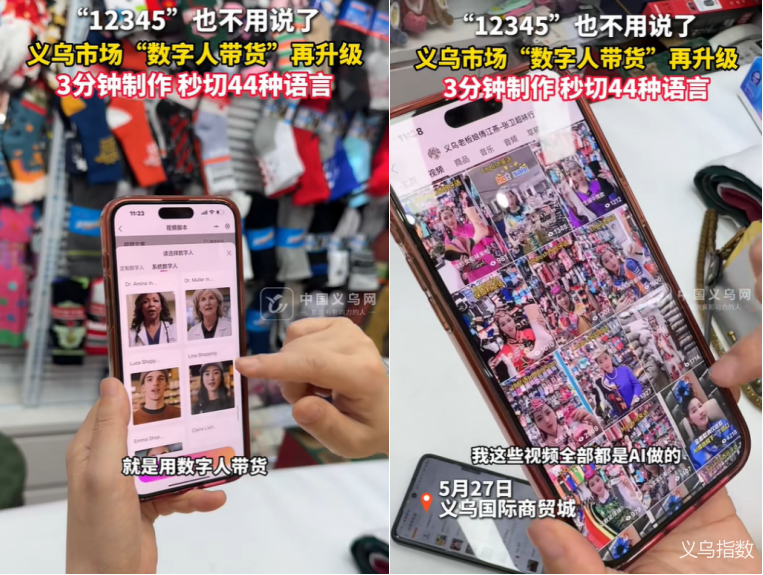
Merchants in Yiwu Market have gone viral by using digital humans to sell goods. Image source: Yiwu Index
The third is to reshape the content production and customer acquisition model. Through AI digital humans, merchants can generate multi-language marketing content in batches within a relatively short period of time and distribute it to social media and e-commerce platforms at home and abroad, achieving a transformation from "passively waiting for customers" to "actively acquiring customers globally". Content production no longer relies on a few professionals.
The fourth is to build an all-weather and standardized foreign trade service system. By deploying AI digital humans at core touchpoints such as official websites and mini-programs, enterprises can create a dialogue assistant that "can listen and speak, and answer all questions". This enables the automation of front-end services from product introduction, enterprise explanation to inquiry guidance, upgrading the originally highly labor-intensive foreign trade customer acquisition process to a 24-hour online, standardized intelligent reception system. Achieve a dual improvement in service accuracy and efficiency.
With the increasing maturity of digital avatar and intelligent agent technologies, a new era of individual entrepreneurship may be ushered in in the future, and a large number of "one-person companies" will also emerge in the field of foreign trade. Every individual entrepreneur can have a digital avatar that combines content creation, customer reception and sales conversion capabilities, and the threshold for starting a business is thus lowered.
At present, the application of AI digital humans in Yiwu is mainly concentrated in scenarios such as multilingual product introduction and marketing content production, and has not yet been deeply integrated into core trade chains such as transaction matching and order fulfillment. In the future, with the development of technology, the integration of AI digital humans and business scenarios in high-frequency business links such as "inquiring about orders, finding goods, and visiting markets" is expected to continue to improve.
Written at the end
While the accelerated implementation of AI digital humans is taking place, opportunities and risks coexist. A large number of agents and shell manufacturers have flooded in, and the quality of digital human products varies greatly. The gap between the application effect and the promotional expectations has gradually weakened the trust foundation of some users. To regulate the industry order, regulatory policies have been rolled out intensively, and platforms have also tightened their entry requirements for applications such as virtual human live streaming, which to some extent has cooled down the market.
As the industry gradually returns to rationality, AI digital humans will also shift from being concept-driven to value-driven, proving their efficiency and long-term commercial potential in real business.
—— The content of this article is translated by Al ——
 My favorites